
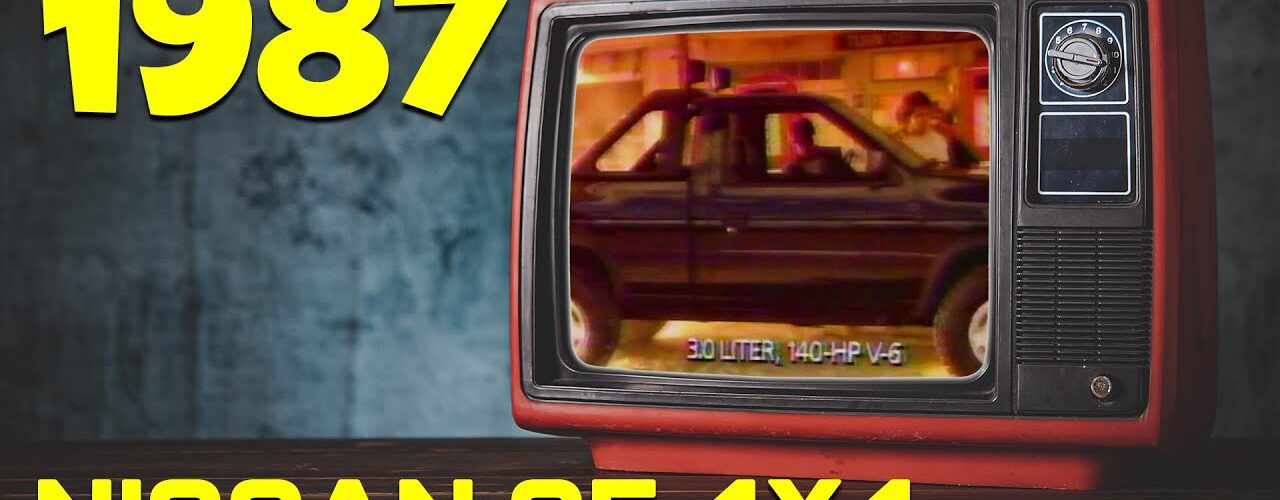
Nissan SE 4×4 Hardbody Mini Truck TV Commercial
Nissan D21
The D21 generation was the successor to the Datsun 720, sold as the Nissan Datsun truck in Japan. The name Navara was used in some markets such as Australia.
Unlike previous generations, this model was available worldwide in two body styles. The “A” body was designed in Japan, and was available in single or dual cab variants, while the “S” body King Cab was designed in the United States, at Nissan’s styling studios in San Diego, California. Each version had unique front styling, with the American version having a different hood, and wider flared front guards. In a few countries, such as Australia, both versions were sold. This was also assembled in Greece for the local market, where it was marketed as the Nissan Pickup and King Cab.
In North America, the company used the name “Datsun” from model years 1980 to 1984 then renamed itself “Nissan” beginning with the 1985 model year line of trucks and cars alike. Nonetheless, the Nissan pickups continued to be marketed in the Japanese home market as the “Nissan Datsun”. The D21 series were called Nissan Hardbody in the United States. “Hardbody” refers to the truck’s double-wall bed and overall styling. The Hardbody was produced for the US market from November 1985 until 1997, and were direct competition to the Toyota compact pickup. The move from the 720 to the D21 Nissan series body style changed in January 1986 for the 1986½ model year so the new D21 and later Hardbody can easily be distinguished from the earlier 720 body style by its two large headlights rather than four smaller lights and a less boxy, more aggressive appearance. The Nissan Pathfinder was derived from the hardbody truck and started in the same model year with chassis code WD21.
In the US, the Hardbody cab styles were ‘Standard’ and ‘King’ (also known as ‘Extended’). Bed lengths were ‘standard’ 6-foot (2 m) and ‘long’ seven-foot. International markets also received the ‘Crew Cab’ (four-door) version with a short four and a half-foot bed.
Versions sold outside of North America came with a host of typically more economical engines, ranging from 1.6-litre gasoline fours up to a 2.7-litre diesel four-cylinder, including the SD25 and TD25 diesel engines. Four-cylinder and V6 engines were available.
In North America, a 2.4-litre four-cylinder Z24i engine was used until 1989 and produced 79 kW (106 hp; 107 PS) in US trim. For many markets a carburetted version of the Z24 was available, usually without much in the way of emissions controls. This model produces 74 kW (100 hp; 101 PS) at 4,800 rpm. For North America, the Z24 was replaced for the 1990 model year by the KA24E of similar displacement: a SOHC engine of respectable performance. Used in the 1990-1997 models, this engine featured a new three-valve-per-cylinder head and produces 97 kW (130 hp; 132 PS), receiving the same engine configuration as the 240SX of the same year. The six-cylinder 3.0-litre VG30i (early years) or VG30E (later years) engine increased power and torque only modestly. This was the only engine option for the one-tonne longbed truck. The V6 was no longer available in the US starting with the 1996 model year because Nissan was unable to meet the requirements of the new OBD-II emissions law in time.
Five-speed, including overdrive, manual transmissions were the most common, but an automatic transmission was an available option. Both rear-wheel-drive (4×2) and four-wheel-drive (4×4) versions were made in quantity. A limited slip differential was standard on the top ‘SE’ trim variants.
Major options included air conditioning, larger wheels/tires, sliding rear window, stereo, and rear bumper. There were several trims available including base, XE, and top-of-the-line SE. The XE could be ordered with a ‘value package’ starting in 1994 which included air conditioning, power mirrors, alloy wheels, and chrome on body trim such as the mirrors and bumpers. The SE was better equipped and could be ordered with the “sport power package” with sunroof, power windows, locks, and mirrors, air conditioning and special 15×8 inch “Robot” alloy wheels.
In 1992, Nissan had a crossover year in which the 1993 model year (mid-1992 to mid-1993 calendar year) had the dashboard of the 1986½–1992 model years with a slightly refreshed body appearance as well as some small interior changes and a revised instrument panel. In a first for the auto industry,[citation needed] this model used the new R134A air conditioning refrigerant.
https://en.wikipedia.org/wiki/Datsun_truck#D21
Video preservation by DDVF.com for educational purposes. Original airdate was Feb 1987.




Add comment